To download
Solar panels shade calculator
How to calculate the suggested minimum distance between photovoltaic panels?
Methodology
Methodology Of The Calculator Of The Minimum Distance Between Solar Panels.
If the installation is to be installed on the ground or on a flat roof, it is extremely important to arrange the next rows of the installation in such a way that the shadow of the previous row does not obscure the next one. For this purpose, the distances of the rows from each other are determined using the calculations for the angle of incidence of solar radiation for December 23, when the sun is lowest above the horizon.
The selection of this distance is closely related to our geographical location, as well as the dimensions of our panel, its orientation and the angle of inclination.
The first step is to calculate the angle of incidence of the sun's rays. For the northern and southern hemispheres above the tropic, this value can be determined using the following formulas. The latitude of the installation location should be substituted for φ.
Methodology
The Selection Of This Distance is Closely Related To Our Geographical Location, As Well As The Dimensions Of Our Panel, Its Orientation And The Angle Of inclination.
where:
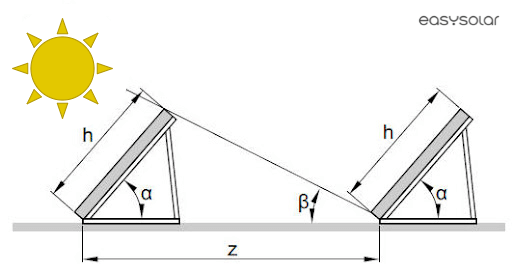
z – distance between rows (m),
α – panel inclination angle,
h – height of panels with the base of the supporting structure (m),
β – the angle of incidence of sunlight on the winter solstice.
Methodology
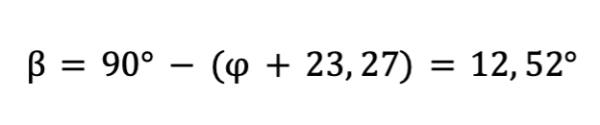
However, it is worth remembering that to determine the minimum distance between the rows, we only need to know the minimum angle of incidence of sunlight during the year, which occurs during the winter solstice (December 22), when the sun is at its zenith over the Tropic of Capricorn. Therefore, the angle can be calculated from the formula:
Knowing the minimum angle of incidence of sunlight during the year, it is possible to determine the distance between successive rows of photovoltaic panels. The figure below shows the schematic diagram used to calculate the row spacing and the formula for the calculation:
Methodology
Solutions To Reduce The Distance Between The Rows Are Acceptable, But It Has A Direct Impact On Energy Yields, Especially In The Winter Months, As Well As On The Lifetime Of Photovoltaic Cells From The Panels Of The Lowest Rows Of The Installation.
Solutions to reduce the distance between the rows are acceptable, but it has a direct impact on energy yields, especially in the winter months, as well as on the lifetime of photovoltaic cells from the panels of the lowest rows of the installation.
An extremely important issue in the situation of reducing the distance is the optimal connection of photovoltaic panels connected in chains in such a way that the possibly shaded rows of panels are strings controlled separately by the MPPT systems of the inverter.
Example
Example
- Calculations of the minimum distance between the panels were made for a multi-family building with a flat roof located in Gdańsk, where the latitude is = 54°21'.
During the winter solstice (December 22), the sun is at its zenith over the Tropic of Capricorn. At that time, Gdańsk has the lowest angle of incidence of sunlight during the year, which is calculated according to the formula:
2. Knowing the minimum angle of incidence of sunlight during the year, it is possible to determine the distance between successive rows of photovoltaic panels. 25 ° was taken as the value of the inclination of the supporting structure and the panel itself. Recommended values are in the range of 25 – 40 °. The height of the selected panel is 165 cm.
Get Started
Download the calculator + full design software
We bring together everything that’s required to design and sell solar systems. Reach more customers, save time and money, and boost sales.
Beyond the calculator
This calculator runs on the EasySolar AI engine. The full software does the rest of the job.
Sizing is the first step of a sale. In EasySolar AI an engineer with professional PV design tools takes it from there: the module layout on the real roof, the yield and energy balance, the price from your own component list, the proposal and even the email to the client. Nothing goes out on its own: you check it, you approve it, you send it.
- Sizing (this calculator)
- Design on the real roof
- Yield and energy balance
- Price from your list
- Proposal and email
- Your review. You send.

Design
Modules on the real roof, not a formula
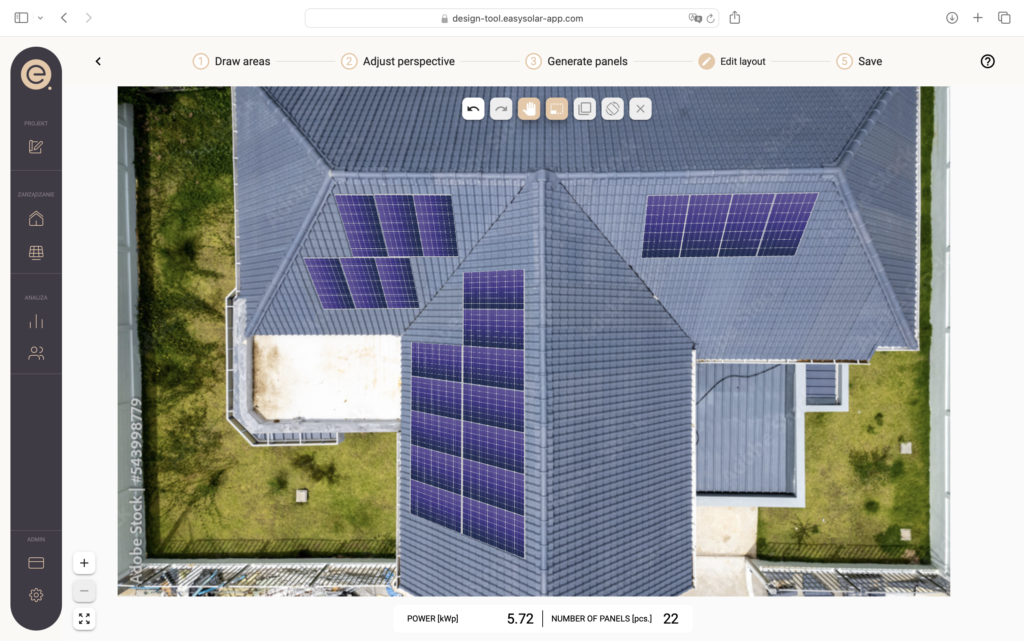
Type the address and the engineer finds the roof on aerial imagery, reads each face with its azimuth and pitch and places the modules. Old imagery or a new building? Use a phone photo from the ground, a drone image or a roof plan. Farms and halls get tables in rows on an orthophoto.
- ✓Roof found, modules placed
- ✓Valuation from your component list
- ✓Energy balance and yield
- …Proposal and email, waiting for your review
The console
One message from the client meeting, the car or your holiday is enough
The console is your design office, with an engineer inside. Send one message about the client and the engineer opens the project, lays out the roof, prices the system from your list, runs the balance and comes back with the proposal and even the email text. Changes sound like talking to a colleague: “add a 5-year loan”. The engineer sends nothing: you review every piece and decide what goes to the client.
Why it pays off
A fast design office with an engineer you trust. That is how you double conversion.
Speed decides the deal: a lead contacted within 5 minutes is 21× more likely to qualify than one contacted after 30.1 With the engineer in EasySolar AI you take a client from the first message to a proposal in 5 minutes, so every offer goes out while the client is still interested. Double your conversion and you install twice as many systems from the same number of offers.
1 J. Oldroyd, Lead Response Management Study, MIT Sloan / InsideSales.com, 2007. The figure describes lead response time in the study sample and is not a measurement of EasySolar AI results. The conversion example shows the arithmetic, not a promise of results.
Ready when you are
Turn this estimate into a proposal in minutes
Send the engineer one sentence about the client. The design, the numbers, the proposal and the email come back for you to review, approve and send. Tariffs, incentives and metering rules for 15 markets are ready on day one, so your first project can start right after signup.
- 520,000+PV projects designed in 2025
- 30countries with active installers
- 2026Google for Startups Accelerator